
Most SaaS channel programmes stall at referral.
I build the ones that get to resell.
Twenty years across Oracle, Cisco, SAP Concur, IFS, Veritas, and Snyk. Enterprise-scale GSI and large SI relationships — the structural channel work that turns an indirect mandate into partner-sourced revenue.
Most partner programmes don't have a strategy problem. They have a structure problem.
The mandate is real. The board wants indirect growth and the budget exists, but the programme was either built transactionally, bought as a framework nobody executed, or handed to someone too junior to fix it. The result stalls somewhere between architecture and pipeline. That’s structural, not cosmetic. It’s exactly where I work.
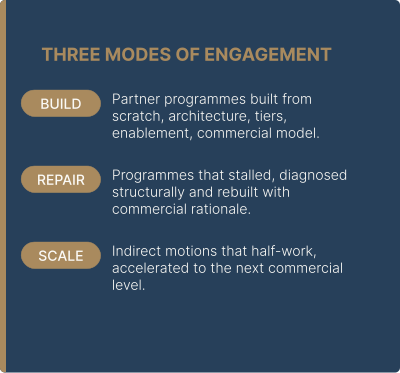
Three modes. One operator who has done each repeatedly, at scale.
From a standing start
Creating a partner programme where none exists: architecture, partner tiers, rules of engagement, enablement infrastructure, and commercial model, before any of it exists.
PROOF POINT
Creating a partner programme where none exists: architecture, partner tiers, rules of engagement, enablement infrastructure, and commercial model, before any of it exists.
When the programme has stalled
Diagnosing why a programme isn’t working and rebuilding it with commercial rationale. Structural intervention, not cosmetic fixes, starting with internal alignment before the partner-facing layer.
PROOF POINT
Veritas, GSI and MSP programme rebuild underpinning $100M+ influenced pipeline, 33% year-on-year revenue uplift. Exponential-e, 32% uplift in partner lead registrations.
Taking it to the next level
A programme that works at a basic level but isn’t performing commercially. Not starting over, accelerating what’s in motion with the architecture and governance that gets it to resell.
PROOF POINT
IFS, partner-sourced revenue CAGR from 10% to 55%. Sole in-country distributor established across India’s Tier 1 SI quadrant: Wipro, Cognizant, TCS, and Tech Mahindra.
A strong fit for some. Not right for everyone.
The mandate is real. The board wants indirect growth and the budget exists, but the programme was either built transactionally, bought as a framework nobody executed, or handed to someone too junior to fix it. The result stalls somewhere between architecture and pipeline. That’s structural, not cosmetic. It’s exactly where I work.
Strong fit if you are…
- A CRO, CCO, or VP of Partnerships with a channel mandate that is missing, broken, or underperforming
- Series B through established enterprise, with board-level appetite for indirect growth
- Working with — or needing to build — GSI, large SI, ISV, or MSP relationships at enterprise scale
- Under commercial pressure to generate partner-sourced pipeline without proportional headcount growth
Probably not yet if you…
- Are pre-product-market-fit or still defining the core product
- Need a generalist or junior hire rather than senior channel pattern recognition
- Want a framework to file rather than an outcome you can hold someone to
You are buying an outcome, not a day rate.
Done this before, at scale
Programme architecture built repeatedly across SAP Concur, IFS, Veritas, and Snyk — not theorised once and generalised from there.
Strategy and execution in one
I diagnose with commercial rigour and stay to build it — rather than handing over a deck and disappearing.
The complexity others avoid
Enterprise GSI and large SI relationships are where most channel professionals stop. That's where I start.
Frameworks that compound
Architecture designed to scale the partner ecosystem cost-effectively. You leave with an engine, not a document.
The work speaks in outcomes.
A few engagements where the channel motion changed measurably.
IFS
10→55%
Partner-sourced revenue CAGR — plus sole in-country distributor for India’s Tier 1 SI quadrant: Wipro, Cognizant, TCS, and Tech Mahindra.
Veritas
$100M+
Influenced pipeline through GSI and MSP programme rebuild on a $1.6bn ARR base. 33% year-on-year channel revenue uplift.
SAP Concur
400%
Delivery capacity expanded through 30+ ERP-integrated ISV activations — enabling MENA market entry two years ahead of plan.
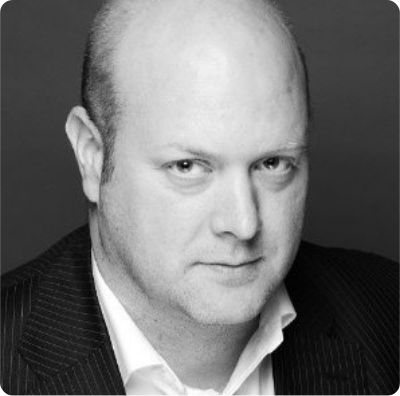
One of the few who has operated at both layers — repeatedly, across vendor sizes and ecosystems.
I’ve spent my career at the intersection of channel strategy and commercial execution. Not in one company, but repeatedly, across different vendor sizes, ecosystem types, and channel maturity levels: Oracle, Cisco, Infor, SAP Concur, IFS, Veritas, and Snyk.
My specialism is the complexity most channel professionals avoid: enterprise-scale GSI and large SI relationships, programme architecture built from scratch, and cross-sector pattern recognition earned from doing this at scale across multiple vendors and contexts.
An Accenture global head of alliances told me, mid-engagement at IFS: “You’re just so damn difficult to do business with. If you got out of your own way, we’d probably do five million in a couple of years.” They were running roughly £1M ARR with us at the time. I treated it as a dataset, not an outlier — called Deloitte, called EY, confirmed the pattern was systemic, and built the programme that fixed it. That’s how I approach every engagement.
I work with Cloud & Commerce on selected partner and channel initiatives, and take on fractional and contract engagements where the problem matches the specialism.
I diagnose the structure first — then build or rebuild it.
01
Diagnose
Map the existing motion, partner tiers, and where the programme leaks. Identify whether the problem is build, repair, or scale. No assumptions — what is actually broken, not what looks broken.
02
Architect
Design the programme structure: tiers, rules of engagement, enablement infrastructure, commercial model, and reporting framework. Built to generate partner-sourced pipeline, not to file away.
03
Embed
Stand up the infrastructure, operate it until it performs, and agree where I stay involved. You leave with an engine, not a deck.
2025, Leading UCaaS vendor:
I brought Redmond in to build a partner programme from the ground up — referral, co-sell and resell motions across the full channel, including the GSI, MSP and reseller ecosystem. It’s the kind of brief that usually takes a team and a year. Redmond gave it shape almost immediately.
What stood out wasn’t just the structural work — the programme architecture, the partner tiering, the rules of engagement — it was his judgment. He knew which motions to prioritise, where the commercial upside actually sat, and how to design something partners would genuinely engage with rather than a framework that looked good on paper. He operated with the independence of someone far more senior than the mandate required, and I trusted him to make the calls.
Crucially, he didn’t just build for the moment. He left us with a clear, prioritised roadmap to execute against — so the work had a forward path that didn’t depend on him being in the room. That’s rarer than it sounds.
If you’re looking for someone who can walk into an ambiguous, greenfield channel problem and turn it into a working programme quickly — and hand back something the team can actually run with — Redmond is exactly that person. I’d work with him again without hesitation.
Turn the channel mandate into partner-sourced revenue.
Tell me where your partner programme stands today — missing, broken, or underperforming — and what you need it to do. I read every message.